











1. Introduction: When Stories Learn to Glow on Screens
Once upon a time, education was a quiet kingdom ruled by chalkboards, dog-eared textbooks, and the occasional overhead projector humming like a tired dragon. In that world, stories were something students read, recited, or analyzed—but rarely experienced. Today, however, we live in a global landscape where stories slip beyond pages, glow on screens, and stretch across websites, apps, games, and augmented realities. These are digital narratives—stories presented, expanded, or shaped using digital technologies, often embedding interactivity, multimedia, and nonlinear exploration.
A generation raised on scrolling, clicking, swiping, and streaming is increasingly drawn to fluid stories rather than static texts. Teachers now ask: What if learning could unfold like a game level? What if a science lesson could behave like a branching quest? What if history could be walked through rather than memorized?
Hence, the question:
Are Digital Narratives the Future of Education?
The short answer is: not only are they the future—they’re already rewriting the present.
But the long answer, the one we will explore for the next several thousand words, reveals a much deeper transformation happening across classrooms, technologies, and the very psychology of how humans learn.
2. What Exactly Are Digital Narratives? A Quick, Crisp Definition
A digital narrative is any story that uses digital tools to be created, experienced, or transformed. Think of:
- interactive videos
- augmented reality (AR) storytelling
- data-driven story maps
- narrative-based video games
- nonlinear web stories
- AI-generated branching adventures
- podcasts that adapt based on user decisions
- virtual reality (VR) storyworlds
Digital narratives can be linear, branching, episodic, dynamic, immersive, or collaborative. What makes them revolutionary is that they turn the learner from a passive receiver into an active navigator of meaning.
This shift—from reading a story to participating in one—is precisely why educators are paying attention.
3. Why Humans Learn Best Through Stories
Before diving deeper, a key truth:
The brain is a storytelling machine.
Neuroscience shows that humans remember narratives better than isolated facts. Stories bind memory, emotion, and cognition into one experience. In psychological terms, narrative coherence helps us structure our understanding of the world.
Traditional education uses stories in predictable ways: reading a novel, examining a case study, or interpreting a historical event. But these formats are often static and unidirectional.
Digital narratives take advantage of the brain’s natural wiring but amplify it with interactivity:
- A student doesn’t just read about climate change—they navigate a simulation where decisions alter the planet.
- A learner studying physics doesn’t just memorize formulas—they play with virtual forces that reshape the environment around them.
- Someone studying literature doesn’t only analyze themes—they step inside the narrative arc.
Storytelling is ancient. Digital storytelling is simply its next evolutionary jump.
4. The Core Advantages of Digital Narratives in Education
Let’s examine why educators across the globe are turning toward this medium.
4.1 Motivation Through Engagement
Digital narratives don’t demand attention—they earn it.
Interactivity awakens curiosity. Multimedia ignites emotional response. Choice empowers agency. Feedback loops activate dopamine. This is a far cry from reading Chapter 7 at home and hoping absorption happens.
Digital narratives:
- transform dull content into captivating missions
- turn passive readers into explorers
- make learning “sticky” through participation
- encourage persistence by rewarding decisions
Engagement isn’t a superficial perk—it is the cognitive engine that drives learning.
4.2 Multimodal Learning for Diverse Minds
Students differ:
- some think in images
- some in sounds
- some in movement
- some in symbols
- some in stories
Digital narratives blend all these modes: text, visuals, audio, animation, spatial reasoning, interactivity, and emotional immersion. This inclusivity offers an advantage over traditional textbooks, which privilege a narrow slice of learning styles.
In a digitally narrated lesson:
- an auditory learner benefits from narration
- a visual learner benefits from illustrations
- a kinesthetic learner benefits from interactive choices
- a reflective learner benefits from optional depth paths
- an advanced learner benefits from branching complexity
- a struggling learner benefits from scaffolding built into the narrative
It’s the most equitable form of storytelling ever invented.
4.3 Real-World Relevance and “Living Knowledge”
Traditional education often teaches abstract concepts. Digital narratives contextualize them.
A student doesn’t learn about supply chains—they manage one in a simulated story.
They don’t memorize historical dates—they negotiate alliances across a timeline.
They don’t calculate projectile motion—they use it to solve a narrative puzzle in a physics game.
This contextualization builds:
- problem-solving
- decision-making
- critical thinking
- cause-and-effect reasoning
- real-world applicability
Digital narratives make knowledge alive.
4.4 Personalization Through Adaptive Paths
Traditional curricula follow the one-size-fits-all model. Digital narratives can adapt to:
- difficulty level
- learning pace
- interests
- strengths and weaknesses
- emotional engagement
AI-enhanced narratives can even track user choices and shape the storybased on them. Instead of 30 students reading the same chapter the same way, 30 students experience tailored story-shaped learning journeys.
This personalization may very well be the future of education itself.
5. How Digital Narratives Transform Specific Subjects
Let’s break down how different disciplines are benefiting from narrative-driven digital tools.
5.1 Language Arts: Reading Becomes an Adventure
Interactive novels, hypertexts, and narrative apps allow students to:
- explore alternate endings
- interpret nonlinear text routes
- examine character motivations through decision paths
- collaborate on storyworld creation
Students don’t merely study literature—they experience narrative structure firsthand, gaining deeper appreciation of themes, pacing, and perspective.
Writing skills also flourish when students compose digital stories enriched with soundtracks, GIFs, or visual metaphors.
5.2 History: Time Travel for the Mind
History taught as a list of dates is forgettable.
History told as an immersive narrative is unforgettable.
Digital narratives:
- reconstruct ancient cities
- simulate diplomatic negotiations
- visualize migrations and conflicts
- allow students to “become” historical figures
Instead of memorizing the Treaty of Versailles, learners navigate the political tensions leading up to it, seeing how small decisions cascade into large consequences.
History stops being “what happened” and becomes “why it mattered.”
5.3 Science: Experiments Without Hazard
Digital storytelling in science creates:
- interactive labs
- molecular visualizations
- physics-based puzzles
- planetary simulations
- evolutionary story arcs
A biology narrative might follow a cell as it navigates threats.
A physics narrative might present gravity as a mischievous force that learners must manage.
A chemistry narrative might gamify reactions as character-driven interactions.
Abstract science becomes intuitive and visually grounded.
5.4 Mathematics: Stories of Logic and Pattern
Math often suffers from being taught as a procedure rather than a meaning-making system. Digital narratives help by:
- embedding math problems into stories
- creating puzzles rooted in real-world math
- visualizing geometric transformations
- narrating the logic behind equations
- providing adaptive scaffolding through story steps
Suddenly, math isn’t an exam subject—it’s part of an adventure.
5.5 Social-Emotional Learning (SEL): Stories that Build Empathy
Digital narratives shine brightest in the social realm:
- empathy-building simulations
- perspective-switching stories
- emotional choice scenarios
- conflict-resolution narratives
These experiences help students understand diversity, ethics, and interpersonal skills far more effectively than lectures.
6. Tools and Formats Driving the Movement
Digital narratives come in many forms, each with unique educational potential.
6.1 Interactive Video Platforms
These tools allow:
- branching pathways
- embedded quizzes
- character-driven lessons
- instant feedback loops
They’re particularly powerful in blended and flipped classrooms.
6.2 Educational Games and Interactive Storyworlds
Game-based learning merges narrative progression with skill development. Examples include:
- exploration games
- puzzle narratives
- role-playing simulations
- decision-based quests
Game mechanics reinforce learning objectives seamlessly.
6.3 VR and AR Narratives
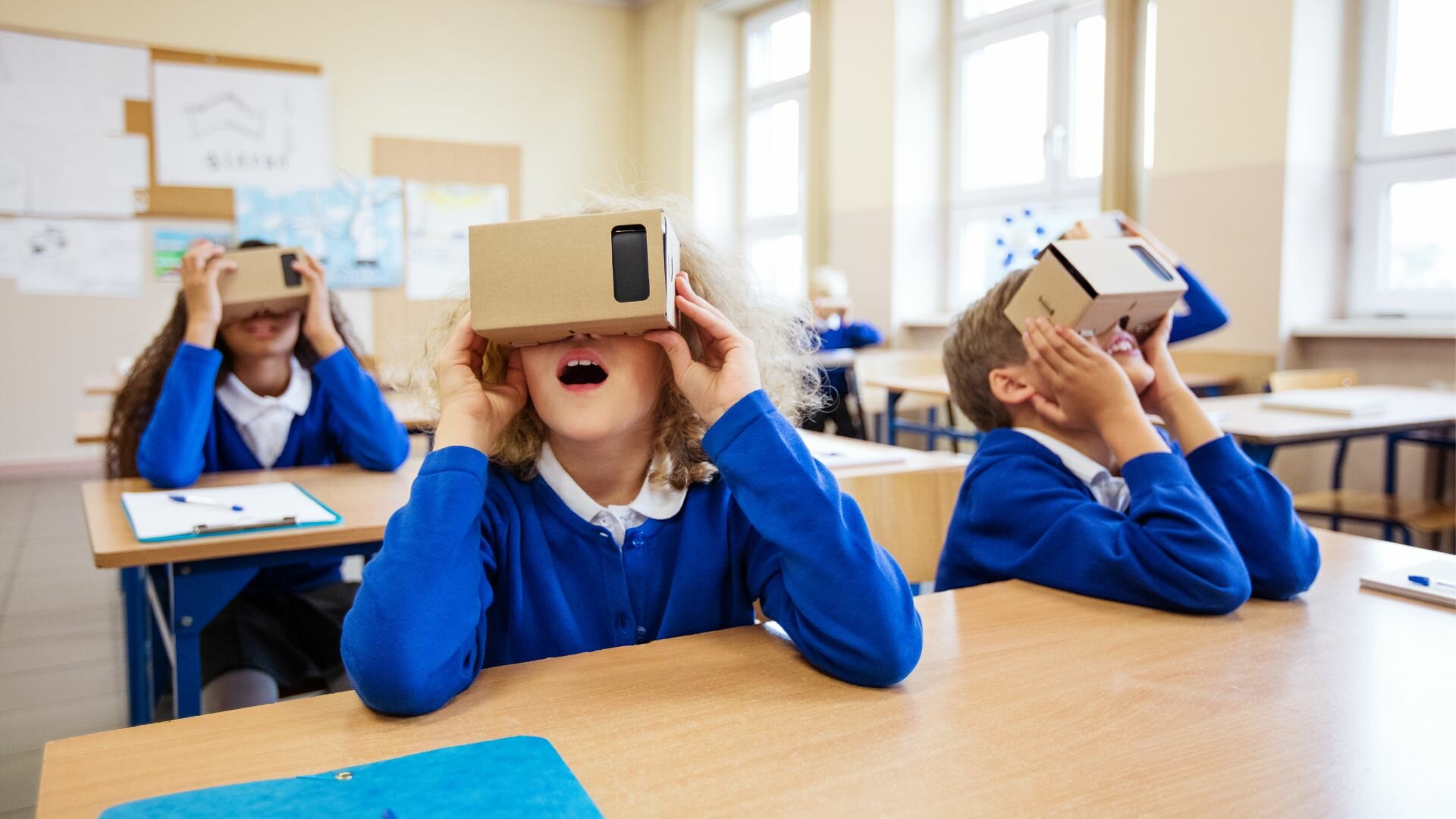
VR allows full immersion.
AR overlays story layers onto the physical world.
A student might walk inside a molecule, float through space, or see ancient ruins materialize on their classroom desk. These narratives offer embodiment—the most powerful form of experiential learning.
6.4 AI-Driven Story Engines
AI can:
- generate alternative endings
- respond to student questions in character
- adapt challenge levels
- create dynamic environments
This introduces near-infinite narrative possibilities.
6.5 Collaborative Digital Story Creation Tools
Tools for building narratives help students:
- write
- design
- storyboard
- animate
- code
- edit
- publish
This fosters creativity, teamwork, and digital literacy—core skills for the modern age.
7. Challenges: The Dragon in the Digital Cave
Digital narratives are powerful, but not perfect. The path forward must navigate key challenges.
7.1 Access Inequality
Not all students have:
- high-speed internet
- tablets or computers
- VR headsets
- stable digital infrastructure
A future where digital narratives dominate education must be matched with investments in equitable access.
7.2 Teacher Training Gaps
Many educators were trained in traditional methods. A sudden leap into interactive narrative pedagogy requires:
- guided training
- professional development
- technical support
- ongoing mentorship
Without teacher confidence, digital narratives remain underutilized.
7.3 Time and Curriculum Pressure
Teachers often feel chained by standardized assessment. Integrating digital narratives can feel risky or time-consuming. Schools must reimagine assessment to value:
- creativity
- decision-making
- problem-solving
- critical thinking
Narrative learning requires autonomy, not rigid pacing guides.
7.4 Cognitive Overload
If poorly designed, digital narratives can overwhelm rather than enlighten. Good instructional design balances:
- simplicity with richness
- interactivity with clarity
- exploration with direction
The goal is not to dazzle learners, but to deepen understanding.
8. Psychological Foundations: Why Digital Narratives Work
Let’s dive deeper into the psychological mechanics.
8.1 Narrative Transportation
When immersed in a story, the brain’s sensory, emotional, and cognitive regions synchronize. This “transported” state enhances:
- memory
- attention
- empathy
- comprehension
Digital narratives deepen transportation through sensory layering.
8.2 Agency and Choice
The simple act of choosing:
- increases engagement
- strengthens motivation
- improves learning outcomes
Agency transforms “This is what I’m being taught” into “This is what I’m discovering.”
8.3 Feedback Loops
Instant feedback reinforces learning at the optimal moment. In narratives, this feedback feels embedded within the story world—not imposed externally.
8.4 Emotional Anchoring
Students remember emotionally charged moments. Digital stories provide:
- tension
- conflict
- surprise
- resolution
This emotional arc boosts both comprehension and retention.
9. Digital Narratives and the Future of Assessment
If narrative-driven learning becomes mainstream, assessment must evolve too.
Imagine assessments where students:
- defend their narrative choices
- analyze the consequences of their decisions
- solve problems embedded in stories
- demonstrate learning through digital creation
Assessment becomes a form of storytelling itself.
This approach may finally solve the decades-old mismatch between how students learn and how they are tested.
10. Ethical Considerations: Narrative Responsibility
Digital narratives carry power—and ethical responsibility:
- ensuring unbiased story structures
- avoiding manipulation
- protecting data privacy
- supporting diverse representation
- empowering student agency
- avoiding over-gamification
The future must balance innovation with ethics.
11. Are Digital Narratives Truly the Future of Education?
Let’s evaluate the core components:
1. Engagement – unmatched
2. Adaptive learning – transformational
3. Real-world context – powerful
4. Creativity and expression – limitless
5. Immersion and simulation – unparalleled
6. Technological scalability – rapidly expanding
7. Psychological alignment with how humans learn – ideal
Digital narratives are not a fad. They are not supplementary. They are not decorative.
They are the most natural evolution of educational storytelling—a practice as old as humanity.
Education has always relied on stories. Digital technology simply gives stories new abilities:
- they can listen
- they can adapt
- they can respond
- they can grow
- they can branch
- they can immerse
When these capabilities meet pedagogy, the result is a powerful fusion that can reshape classrooms worldwide.
12. Conclusion: The Next Chapter of Learning
We are standing at a pivotal point in educational history. Digital narratives are not just enhancing learning; they are reshaping the fundamental structures of how knowledge is delivered, absorbed, and applied.
Imagine generations of students who:
- learn history by exploring it, not memorizing it
- grasp science by simulating it, not imagining it
- master mathematics by interacting with it, not fearing it
- develop empathy by living through others’ stories
- cultivate creativity by authoring their own digital worlds
The classroom of the future will not be built on lecture rows—it will be woven from branching choices, immersive experiences, and living storyworlds.
So, back to our guiding question:
Are Digital Narratives the Future of Education?
Yes.
They are the ink on the next page of humanity’s learning journey, already forming lines before our eyes. And as we turn that page, we find a world where every student becomes not just a learner but a storyteller of their own future.